
What every media executive should understand about live contribution and distribution workflows, and why your choice of service partner determines whether the feed makes it.
- Getting a live signal from a venue to international broadcasters involves six distinct stages, each of which can fail independently.
- Most production teams already have compatible gear. The complexity sits in coordination and redundancy, not equipment.
- Occasional Use (OU) services let broadcasters book the full signal chain per event, without long-term capacity commitments.
- iKOMG provides end-to-end OU services including European and Middle Eastern teleports, satellite distribution across 40+ satellites, IP contribution, 24/7 network operations support, and simultaneous OTT delivery from a single managed service.
- The business case for a single managed-service partner is operational simplicity and faster fault resolution during a live event.
The Business Problem Most Executives Overlook
When a broadcast goes wrong during a live event, the question is never which piece of technology failed. The question is how long it takes to find the failure and fix it when multiple vendors are involved.
A rights holder distributing a live sports fixture to regional affiliates in three continents may be working with a contribution vendor, a satellite operator, a teleport facility, and a streaming CDN. Each vendor is responsible for one portion of the signal chain. None of them has full visibility into what the others are doing. When the feed drops on a broadcaster’s end, the diagnostic process starts with phone calls.
This is the core operational problem that the choice of service provider is supposed to solve. For sports rights holders in particular, where events are time-bound, scheduled months in advance, and watched by audiences who will not tolerate interruptions, the cost of that diagnostic delay is not abstract. It is lost airtime, reputational damage, and in some cases contractual exposure with affiliates.
The Six Stages of a Live Contribution and Distribution Workflow
Understanding what each stage does makes it easier to evaluate what a managed service actually covers and where the gaps tend to appear.
Stage 1: Venue Capture
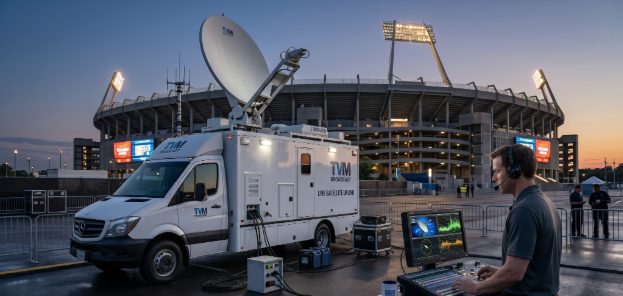
Camera feeds are consolidated at the venue’s technical hub, whether that is an outside broadcast (OB) van parked outside a stadium, a temporary control room inside an arena, or a fixed technical facility. This is where the production comes together before transmission begins. For major sports events, this hub is typically coordinating feeds from multiple camera positions simultaneously.
Stage 2: On-Site Encoding
The consolidated video signal is compressed and packaged into a format suitable for transmission. The codec used at this stage affects both the bandwidth required and the total delay from camera to viewer. Most professional OB crews already carry encoding equipment compatible with current broadcast standards.
Stage 3: Contribution Transport
The encoded signal travels from the venue to the teleport. It can travel via satellite uplink from an OB vehicle or flyaway kit, via IP protocols such as SRT (Secure Reliable Transport) or RIST (Reliable Internet Stream Transport) over the public internet or private fiber, or via a combination of both paths running simultaneously. In practice, most professional OU workflows run both a primary and a backup path, keeping the second warm rather than cold so that switchover is immediate if the primary drops.
Stage 4: Teleport Reception and Processing
The signal arrives at a teleport facility, where it is decoded, monitored, and conditioned before onward distribution. Signal conditioning covers level correction, format conversion, and quality checks. This is the stage where technical problems in the contribution path are most visible if proper monitoring is in place.
Stage 5: Onward Satellite Distribution
The processed feed is uplinked from the teleport to satellite, from where broadcasters and downlink facilities in multiple regions can receive it. The coverage footprint of the satellite determines which regions can receive the signal. For sports events with international rights holders across different continents, including broadcasters in the Americas, this stage may involve multiple satellites to ensure the feed reaches all licensed territories.
Stage 6: Broadcaster Reception and OTT Delivery
Rights holders receive the feed at their downlink facilities. At the same time, the signal can be routed to streaming platforms and CDN endpoints, allowing satellite broadcast audiences and online streaming audiences to receive the feed from the same contribution session, without a separate contribution path. For sports rights holders managing simultaneous linear and digital audiences, this removes a common source of operational complexity.
What Occasional Use Services Provide
Occasional Use (OU) refers to a booking model in which satellite capacity and managed infrastructure are contracted per event rather than held on a permanent circuit. The appeal for most rights holders and production teams is straightforward: a federation running a seasonal sports circuit does not need a permanent uplink consuming budget year-round. A news network covering a one-off summit does not need to build a dedicated circuit for three days.
The practical scope of an OU engagement covers the full signal chain described above: on-site encoding support, contribution transport, teleport reception, onward satellite distribution, and optional OTT or CDN routing, managed under a single service agreement. The buyer pays for what they use.
How iKOMG Approaches Live Event Distribution
iKOMG OU provides occasional use and live event services that cover the full signal chain from venue to broadcaster and streaming destination under a single managed service agreement. Rather than coordinating between a contribution vendor, a satellite operator, a teleport facility, and a streaming provider separately, clients work with one partner who holds visibility across the entire workflow.
This is particularly relevant for sports rights holders managing live event distribution across multiple regions. iKOMG’s infrastructure supports events from venue capture through to delivery across Europe, the Middle East and North Africa, Asia-Pacific, and the Americas, with redundancy built into the contribution and distribution path rather than added reactively after a fault.
When something goes wrong during a live event, iKOMG’s 24/7 staffed Network Operations Center can identify where in the chain the fault has occurred and act on it without the diagnostic delay that comes with multi-vendor setups. Backup paths can be pre-configured before the event begins, so failover is immediate rather than reactive.
iKOMG also supports simultaneous delivery to both satellite broadcasters and OTT or streaming platforms from the same session, removing the need to run separate contribution arrangements for linear and digital audiences.
| Capability | Detail |
| Teleport facilities | European teleports in Rome, Italy and Ljubljana, Slovenia, plus a Middle Eastern teleport facility |
| Satellite access | 40+ satellites across approximately 80°E to 45°W |
| Regional coverage | EMEA, APAC, LATAM, NA and ANZ |
| IP contribution protocols | SRT and RIST via the Global SRT Mesh Network |
| Signal monitoring | Real-time monitoring via iKOVIEW and iKOPLUS |
| Failover management | Pre-configured backup paths via iKOFLOW |
| OTT and CDN delivery | Simultaneous satellite and streaming delivery from one session |
| NOC availability | 24/7 staffed operations at both teleport facilities |
| Booking model | Per-event Occasional Use, no permanent capacity commitment required |
What Decision-Makers Should Take Away
The workflow for distributing a live signal to international broadcasters is manageable. What determines whether a broadcast succeeds is who manages each stage, whether they have visibility across the full chain, and how quickly they can respond when something goes wrong.
For sports rights holders and federations, the stakes are higher than in other broadcast contexts. Events cannot be rescheduled because of a signal fault. Affiliates in multiple time zones expect feeds to arrive on time and at specification. Audiences watching live sport expect continuity. The practical priorities when evaluating a service partner are facility-level redundancy, real-time monitoring, pre-configured failover, and a booking model that matches the frequency of your events. A single managed-service provider who covers all of those areas removes the coordination overhead and diagnostic delays that come with running multiple vendors.
Are you planning to broadcast a live sports event and want to understand what an end-to-end Occasional Use service looks like in practice?
Learn more about iKOMG OU to see how it could work for you.
