
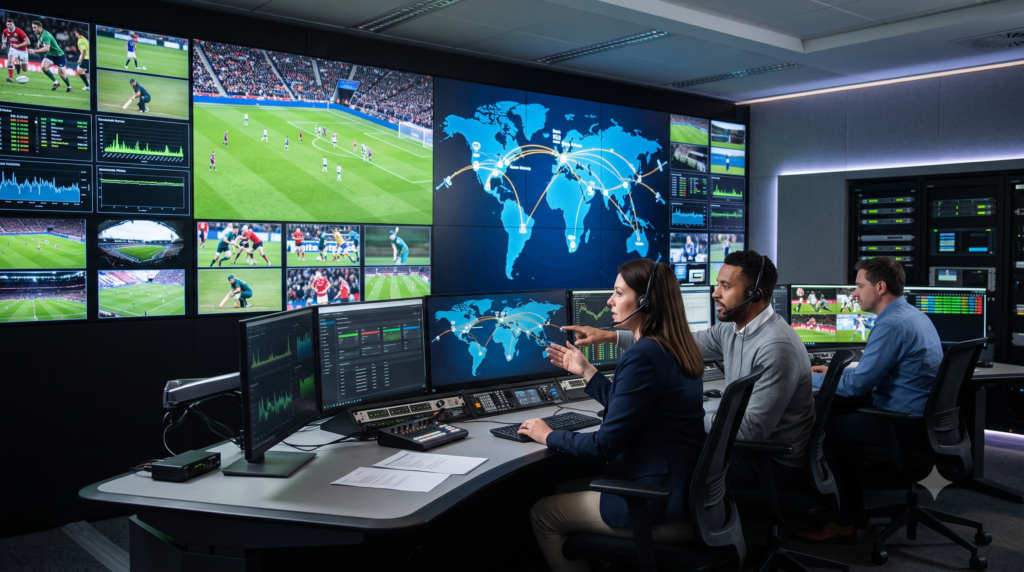
Occasional Use services let sports rights holders access international broadcast infrastructure as a managed, event-based service.
- The simplest way to distribute a live sports event internationally is to use one managed Occasional Use provider instead of building a permanent broadcast network.
- Occasional Use gives an organization temporary access to satellite, fiber, IP, cloud, streaming, monitoring, and event-support capabilities.
- A single accountable provider reduces vendor coordination, permanent infrastructure costs, and the internal expertise required for occasional events.
- iKOMG offers managed sports and live-event services across satellite, IP, cloud, fiber, CDN streaming, commentary, playout, and monitoring.
The simplest way to distribute a live sports event internationally without building your own broadcast network is to outsource the distribution chain to an experienced Occasional Use provider. The rights holder supplies the event feed and defines where it must go; the provider coordinates the temporary infrastructure needed to deliver it.
This approach does not eliminate planning. It replaces network ownership and multiple supplier relationships with a managed service designed around the event.
What an outsourced broadcast network is
An outsourced broadcast network provides temporary access to an existing combination of teleports, satellite capacity, fiber routes, managed IP links, cloud systems, streaming delivery, monitoring, and operational support.
In broadcasting, this model is commonly described as Occasional Use(OU). The customer books capacity and supporting services for a match, tournament, ceremony, or other defined live window. When the event ends, the organization is not left maintaining infrastructure that may remain unused for much of the year.
This model is particularly relevant to federations, leagues, rights holders, and event organizers with valuable international rights but inconsistent broadcast volume. It allows them to reach broadcasters and platforms in new markets without first becoming network operators.
Managed live-distribution models are already established across the broadcast industry. The business principle is straightforward: purchase the reach and operational coverage required without owning every connection underneath it.
How the managed Occasional Use model works
The process should start with destinations rather than technology. The rights holder identifies which broadcasters, platforms, or production partners must receive the event and what each recipient requires.
The Occasional Use provider then designs the route between the event feed and each destination. This can include venue connectivity, signal ingest, format conversion, satellite or fiber capacity, managed IP transport, streaming, monitoring, and the final technical handoff.
The rights holder continues to control its territorial rights, branding, editorial decisions, and commercial relationships. The provider manages the technical delivery workflow and escalation procedures agreed for the live window.
One event can also support several types of output. The main feed may go to television broadcasters over satellite or fiber, while separate versions are delivered through IP or CDN workflows. Commentary, playout, social streaming, and highlight production can be added when the commercial plan requires them.
After the event, the temporary capacity is released. The organization pays for the infrastructure and services required for that event rather than maintaining a permanent network throughout the year.
The limitations of outsourcing
Outsourcing simplifies infrastructure ownership, but it does not remove the need for clear planning. The rights holder must still provide an accurate destination list, event schedule, receiving specifications, language requirements, and territorial restrictions.
The provider’s responsibility must also be explicit. When different suppliers control venue connectivity, transport, streaming, commentary, and monitoring, the buyer may still carry most of the coordination burden.
The value of an outsourced network therefore comes from consolidated accountability, not simply from using external companies. Executives should establish who owns the route from ingest to confirmed reception, who contacts receiving broadcasters, and who manages escalation when a feed is interrupted.
Event complexity also affects lead time. A single feed delivered to one established broadcaster is different from a tournament involving several venues, territories, languages, and platform types. Fast activation is valuable, but commercial approvals, receiver coordination, and delivery testing still matter.
The lowest transport price may not produce the lowest total operating cost. A collection of inexpensive suppliers can create more contracts, support channels, handoffs, and management work than one managed service.
Comparing the three main distribution approaches
| Approach | What the organization must manage | Best suited for | Why it matters |
| Build an internal network | Infrastructure, capacity contracts, routing, monitoring, staffing, maintenance, and upgrades | Broadcasters with continuous and predictable distribution volume | Provides direct control but creates substantial fixed costs and operational responsibility |
| Assemble event vendors | Separate suppliers for venue contribution, transport, streaming, commentary, and monitoring | Organizations with experienced internal broadcast operations teams | Offers flexibility but increases coordination and fragments accountability |
| Use a managed Occasional Use provider | Event objectives, rights instructions, destinations, approvals, and partner relationships | Rights holders needing temporary international reach | Converts infrastructure into an event-based service managed through one operating partner |
For organizations that distribute live content throughout the year, owning or directly operating more of the network may be commercially reasonable. For occasional tournaments, qualifiers, one-off matches, or early international expansion, a managed OU service is usually simpler.
How iKOMG fits the outsourced-network model
iKOMG OU is structured around managed Occasional Use distribution. It can provide worldwide satellite capacity, fiber and IP delivery, teleport services, monitoring links, CDN streaming, SNG uplink, remote commentary, smaller-scale production, and event coordination.
Satellite, IP, cloud, and fiber distribution, scalable service models, rapid deployment, and 24/7 global NOC and engineering support as parts of iKOMG OU.
The practical benefit is not that every event must use every available service. It is that the distribution mix can be selected around each event and destination.
A rights holder may require satellite delivery for one national broadcaster, managed IP delivery for another, multilingual commentary for a third market, and CDN streaming for digital platforms. These outputs can be coordinated as parts of one event workflow rather than treated as separate infrastructure projects.
Practical takeaways
Start by documenting the event schedule, territories, receiving partners, feed formats, languages, digital destinations, and support requirements.
Next, determine whether one provider can own the delivery route from ingest to confirmed reception. Establish who monitors each feed, communicates with receiving partners, and manages technical escalation.
Finally, compare outsourcing with the real alternative. The alternative is not merely purchasing a transport connection. It can involve permanent infrastructure, specialist employees, multiple supplier contracts, network maintenance, and the internal time required to make those components function as one system.
For most organizations producing occasional international sports events, outsourcing is the simplest model because it provides access to a broadcast network when needed without turning the rights holder into a network operator.
