
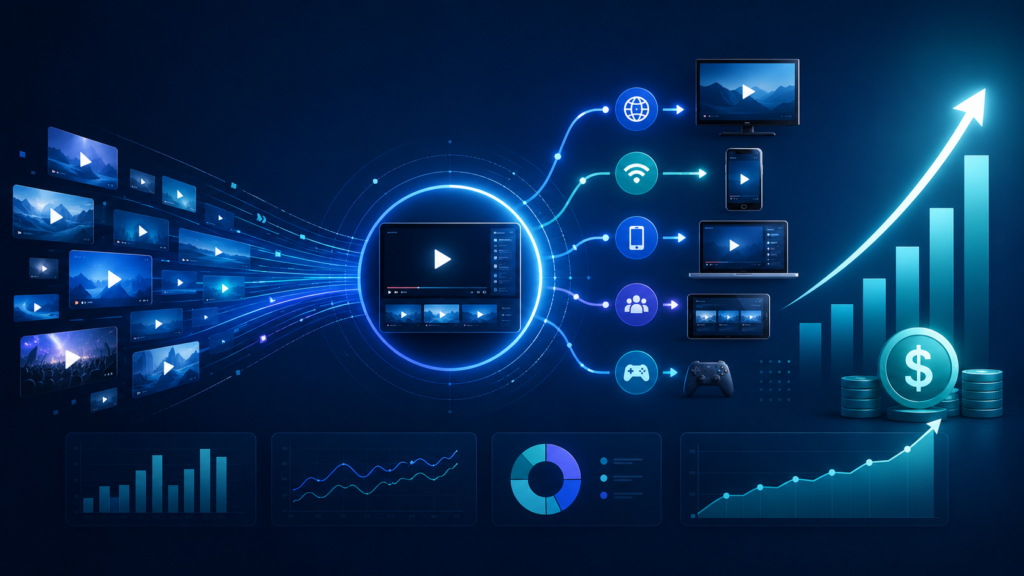
Media companies can increase advertising revenue by distributing content across more monetizable channels, improving content packaging, and connecting each impression to stronger sources of advertiser demand.
- Wider distribution increases ad revenue only when it creates additional viewable and measurable advertising inventory.
- Media companies should evaluate distribution platforms according to audience fit, monetization options, rights requirements, and reporting capabilities.
- Accurate metadata, regional packaging, and device-compatible delivery improve the likelihood that content will be discovered and monetized.
- Revenue performance should be measured through fill rate, effective CPM, viewing time, completion rate, and revenue per distributed asset.
- iKOMG combines content sourcing, preparation, global delivery, and connected TV monetization services within a managed distribution model.
Improving content distribution can increase ad revenue by placing content in front of more relevant viewers, creating more sellable impressions, and making those impressions accessible to a wider pool of advertisers. However, simply adding platforms does not guarantee higher revenue. Distribution must be designed around monetizable reach rather than total reach.
The commercial opportunity is substantial, with digital video advertising continuing to grow rapidly and ad-supported viewing dominating how audiences consume television. Streaming, in particular, has become the primary driver of ad-supported engagement, creating new avenues for monetization across platforms.
What Content Distribution Means for Ad Revenue
Content distribution is the process of preparing and delivering video programming to the platforms, regions, devices, and audiences where it can be watched.
For an advertising-supported media company, distribution determines how much monetizable inventory exists. A channel available through one regional application produces fewer potential impressions than the same channel delivered through connected TV platforms, mobile applications, web players, FAST services, and operator networks.
The relationship can be simplified as:
Ad revenue = monetizable viewing volume × advertising fill rate × effective CPM
Distribution primarily affects monetizable viewing volume. The distribution and advertising model together influence fill rate and effective CPM.
This distinction matters because a company may expand its theoretical audience without improving revenue. A new platform that produces little viewing, lacks sufficient advertiser demand, or cannot support the required ad formats may increase operational complexity without creating meaningful income.
How Better Distribution Creates More Advertising Revenue
A stronger distribution strategy improves revenue through four main mechanisms.
More monetizable viewing sessions
Adding suitable platforms and territories creates more opportunities for viewers to encounter the content. Each additional completed viewing session can generate pre-roll, mid-roll, display, sponsorship, or programmatic advertising inventory.
The most valuable expansion opportunities are not necessarily the platforms with the largest total audience. They are the platforms where the content matches viewer demand and where advertising can be sold reliably.
Access to more sources of advertiser demand
Advertising inventory becomes more valuable when it can be offered to multiple demand sources rather than a single buyer or sales team.
Connected TV marketplaces, supply-side platforms, demand-side platforms, direct advertisers, and regional sales partners may all compete for eligible inventory. This can improve fill rates and reduce the amount of inventory that remains unsold.
The iKOMG content aggregation service provides a CTV advertising marketplace designed to connect inventory with multiple demand sources and monetize it across platforms, devices, and ad formats.
Better content discovery
Content cannot generate ad revenue when viewers cannot find it.
Clear titles, program descriptions, genre classifications, language data, artwork, EPG information, and regional metadata help platforms categorize and recommend programming. Better discovery can increase channel starts, viewing time, and repeat sessions without requiring the content owner to produce additional programming.
Metadata should therefore be treated as part of the revenue infrastructure, not as a final administrative step.
More usable versions of each asset
A single video asset may require different packaging for a FAST channel, OTT library, mobile application, web player, or operator platform.
Preparing the correct resolution, aspect ratio, language, caption file, ad markers, streaming format, and schedule can make the same content commercially usable in more environments. This increases the potential return from existing rights and production investments.
Comparing Content Distribution Models
| Distribution model | Main advantage | Monetization potential | Main limitation | Why it matters |
| Owned website or application | Direct audience relationship and greater control | Direct sales, sponsorships, subscriptions, and programmatic ads | Requires audience acquisition and platform management | Provides control but may limit scale |
| Individual platform agreements | Direct access to selected audiences | Platform-specific advertising or revenue sharing | Each launch requires separate negotiation and operations | Works well for a small number of priority platforms |
| FAST channel distribution | Continuous, free viewing environment | Programmatic CTV ads, sponsorships, and revenue sharing | Requires scheduling, metadata, ad readiness, and ongoing management | Converts content libraries into recurring viewing inventory |
| Regional operator distribution | Access to established local audiences | Carriage arrangements, local advertising, or hybrid models | Rights and commercial terms vary by market | Can accelerate entry into new regions |
| Managed content aggregation | Centralized sourcing, preparation, delivery, and monetization access | Multiple platforms and demand sources through one operating relationship | Requires service fees or revenue sharing | Reduces the operational burden of managing many separate distribution paths |
The correct model depends on the content library, target territories, rights structure, internal operating capacity, and monetization goals. Many media companies use a combination rather than relying on one route.
Where Distribution Revenue Commonly Leaks
Distribution expansion can fail to produce expected revenue when the underlying commercial workflow is incomplete.
- Poor platform selection creates reach without meaningful viewing. Content should be matched to the language, genre preferences, devices, and consumption habits of each target audience.
- Weak metadata reduces discoverability and contextual advertising opportunities. A generic description gives recommendation and advertising systems less information about the program.
- Low advertising fill rates leave eligible breaks unsold. Content owners should review demand access, regional buyer coverage, price floors, and fallback advertising arrangements.
- Inconsistent ad markers can prevent ads from being inserted correctly. This can reduce inventory or create a poor viewer experience.
- Fragmented reporting makes it difficult to determine which platforms, programs, or territories are profitable. Revenue should be evaluated at the distribution-path and content-asset level.
- Unclear rights can delay launches or restrict monetization. Advertising rights, platform rights, language rights, and territorial windows should be confirmed before content is packaged.
How iKOMG Fits a Monetization-Focused Distribution Strategy
iKOMG Content Aggregation and Distribution is designed for broadcasters, media networks, OTT operators, and content owners that want to source, prepare, deliver, and monetize programming across multiple environments.
iKOMG sources content through teleport and fiber connections, prepares feeds for different delivery requirements, and supports broadcast and streaming formats including SRT, RIST, MPEG-TS, HLS, and DASH. The company also advertises content packages containing live television channels and video-on-demand assets for OTT distribution.
The business benefit is operational consolidation. Instead of establishing separate technical and commercial workflows for every platform, a content owner can use one managed partner for parts of the sourcing, preparation, delivery, and advertising process.
This model is particularly relevant when a company wants to:
- Launch content in several regions without creating local distribution teams
- Convert an existing library into OTT or FAST programming
- Add connected TV advertising to previously unmonetized content
- Combine direct distribution agreements with monetization for unsold inventory
- Reduce the number of vendors involved in delivery and advertising operations
The service does not remove the need for a content strategy. Audience demand, content rights, platform terms, advertiser interest, and viewing performance still determine whether additional distribution becomes profitable.
Practical Steps for Increasing Ad Revenue
Media executives should begin by mapping every content asset against four factors: audience demand, distribution rights, technical readiness, and monetization options.
Next, prioritize platforms according to expected revenue contribution rather than logo value or estimated reach. A smaller platform with strong viewing time and advertiser demand may be more profitable than a large platform where the content receives little promotion.
Each launch should have a defined measurement framework. Important metrics include:
- Total viewing hours
- Monetizable impressions
- Advertising fill rate
- Effective CPM
- Ad completion rate
- Revenue per viewing hour
- Revenue per asset
- Distribution and operating cost
- Net contribution by platform and territory
The objective is not maximum distribution. The objective is profitable distribution that turns content into repeatable, measurable advertising inventory.
