
A plain-language explanation of short-term satellite and IP booking for live events, and where a dedicated OU provider fits in
Occasional use (OU) is short-term satellite or IP transmission capacity booked for a single event or a defined window, rather than a full-time channel contract. It covers the temporary, short-notice transmissions that sports and live event broadcasters need to get a signal from a venue to a teleport or distribution network. Satellite industry providers describe OU slots as available from as little as 15 minutes up to about a month, with bookings accepted on short notice, sometimes within 30 minutes of the transmission start. This flexibility is what separates OU from the long-term capacity contracts broadcasters use for full-time channels. iKOMG OU, the sports and live events division of iKO Media Group, is one provider that packages this kind of short-term capacity together with the production and coordination services an event broadcast actually needs.
Yes, occasional use is a real, defined category of broadcast service. It refers to booking satellite, fiber, or IP transport for a limited, event-driven window, distinct from the standing capacity broadcasters use for continuous channel delivery. The key nuance is that OU is not just a satellite booking, in practice, it usually bundles technical delivery with event-specific production support such as uplink trucks, monitoring, and commentary. The rest of this article breaks down how OU actually works and where a dedicated OU provider fits into a live sports or events workflow.
What Occasional Use Actually Covers
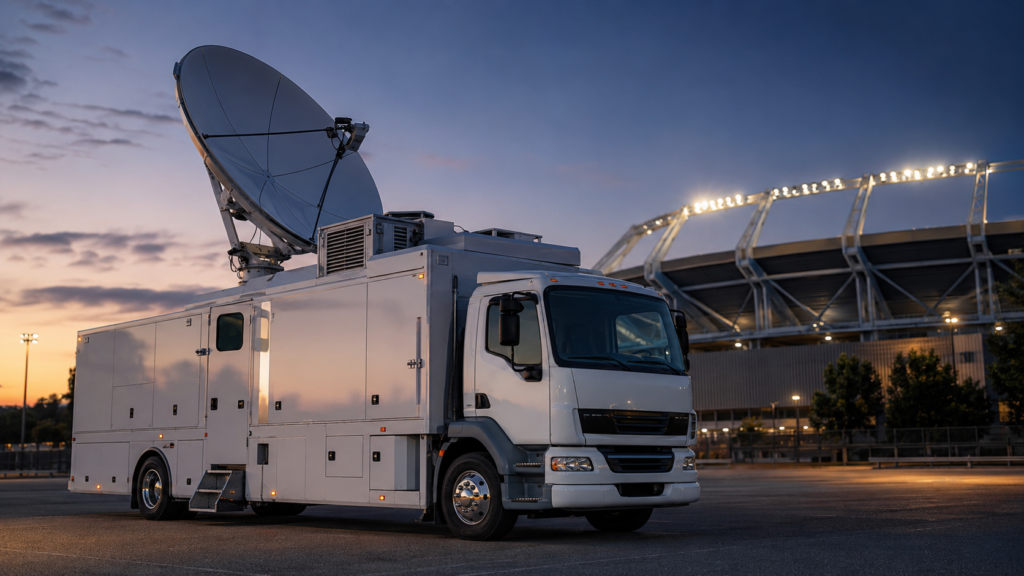
Occasional use gets its name from how it’s billed and scheduled: capacity that’s reserved only for the occasion, not held year-round. The core technical foundation of OU broadcast is temporary and occasional transmission with short notice. In practice, that means SNG vehicles, flyaway kits, or fixed teleport uplinks are booked to carry a live signal from a stadium, arena, or venue to a broadcaster’s playout or distribution point for the duration of the event, and released afterward.
Do you know How Do Broadcasters Distribute Live Sports Feeds Worldwide Without Owning Satellites or Infrastructure?? Learn why the real decision behind Occasional Use is about managing risk exposure, not just avoiding equipment cost.
How an OU Booking Works in Practice
First, a broadcaster or rights holder identifies an event and a transmission window, which can range from a single match to a multi-day tournament. Second, they book satellite capacity, fiber, or IP transport for that window, a process that reputable OU providers can confirm in minutes rather than weeks. Third, the provider handles the technical delivery, satellite turnaround, teleport uplink, fiber or IP transport, and CDN streaming, alongside monitoring to catch signal issues before they reach air. Fourth, for sports specifically, this often extends into production support: remote commentary, small-scale production crews, and event coordination, so the broadcaster isn’t managing multiple vendors for one event. iKOMG OU packages these steps together, offering satellite capacity worldwide, fiber and IP delivery, teleport services, and monitoring links to deliver the feed, alongside CDN streaming, SNG uplink, remote commentary, small production crews, and event coordination to manage it.
Where OU Has Limits
Occasional use is built for events with a defined start and end, not standing distribution. A channel that broadcasts continuously, year-round, needs a long-term capacity contract, not repeated OU bookings, since OU pricing and availability are structured around short, flexible windows rather than guaranteed permanent capacity. OU also depends on provider redundancy and support quality: a booking is only as reliable as the teleport network and NOC support behind it, which is why 24/7 engineering support and signal monitoring matter as much as the raw satellite capacity itself.
For more on how accountability holds up when a multi-vendor broadcast fails, see Who Is Liable When a Live Broadcast Fails? The Hidden Risk in Multi-Vendor Distribution.
iKOMG OU at a Glance
| Service | What it does | Why it matters |
|---|---|---|
| Satellite, fiber & IP delivery | Worldwide satellite capacity plus fiber and IP transport for the event window | Covers delivery regardless of venue location or connectivity |
| Teleport & monitoring | Teleport uplink services with CDN streaming and monitoring links | Catches signal issues before they reach broadcast |
| SNG uplink & production | SNG trucks, remote commentary, and small-size production crews | Bundles technical delivery with the production support live events need |
| Event coordination | End-to-end coordination for the booking window | Reduces the number of vendors a broadcaster manages per event |
| Support & deployment | 24/7 global NOC support with booking confirmation within minutes (iKOMG states) | Matches OU’s short-notice nature with equally fast provisioning |
Practical Takeaways for Rights Holders and Broadcasters
For a rights holder or broadcaster planning event coverage, the decision usually isn’t whether to use OU, it’s which provider can confirm capacity fast enough and back it with support during the live window. A provider with global teleport reach, 24/7 NOC monitoring, and bundled production services reduces the coordination burden compared with booking satellite capacity and production support separately. iKOMG OU’s recent partnership with commentary technology provider Spalk reflects this direction, combining distribution infrastructure with localization tools to serve broadcasters covering events across multiple markets and languages.
Have an event on the calendar that needs fast, reliable OU capacity? Visit iKOMG Sports & Live Events to see how OU booking and production support work together.
