
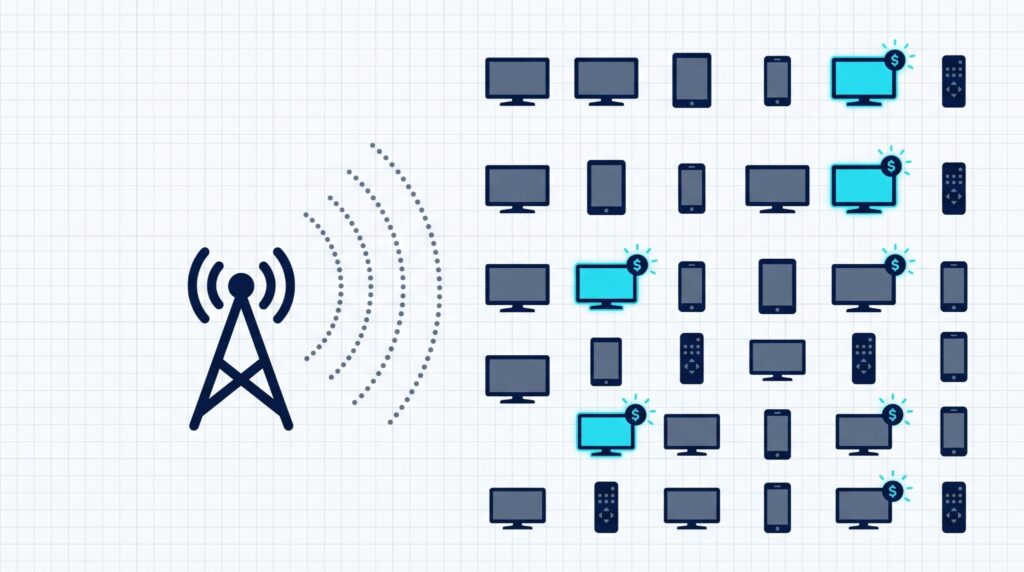
Ad revenue for an OTT or FAST operator is capped by two things before a single ad ever sells: how many households the distribution actually reaches, and how reliably the stream delivers once a viewer presses play. FAST channel ad revenue in the US alone is projected to reach 12 billion dollars by 2027, according to TBI. That growth has pulled in more supply than advertiser demand has matched at the same pace. Industry fill-rate data from Wurl shows ad fill rates trending downward through most of 2024 and 2025 as content supply outgrew advertiser spend. In that environment, an operator’s existing reach and reliability determine how much of its inventory actually converts to paid impressions, not just how much inventory exists on paper. iKOMG’s distribution and monetization services are built around expanding both sides of that equation for OTT and FAST operators.
Better distribution increases ad revenue mainly through two levers: expanding the addressable audience a channel can reach, and protecting the reliability of the stream so impressions actually get delivered and counted. More reach means more households an advertiser will pay to reach at all. More reliability means a higher share of scheduled ad breaks complete without buffering or dropout, and that completion is what determines whether an impression is billable in the first place.
What turns a stream into sellable inventory
An ad slot only has value once three conditions hold: a viewer can reach the channel, the stream stays up long enough for the ad to play in full, and a measurement system can confirm that. Reach without reliability produces inventory that looks good in a channel guide but underdelivers on completion rate. Advertisers and programmatic buyers track that rate closely. Reliability without reach caps revenue at whatever audience already exists, regardless of how clean the delivery is. Distribution strategy, in this framing, is really inventory strategy: every improvement to reach or reliability shows up directly as more sellable, billable ad impressions.
How reach directly expands addressable inventory
Every household a channel can’t reach is inventory that doesn’t exist, no matter how strong ad demand is. Broadband-only FAST distribution excludes households in regions where internet penetration is uneven, a real gap in markets like the Middle East and North Africa. iKOMG’s FAST on SAT service delivers FAST channels over the Eutelsat 7W/8W orbital position, reaching more than 66 million households across MENA that a broadband-only FAST launch would miss entirely. That’s not a technical footnote; it’s new addressable inventory that didn’t exist under an OTT-only or app-only distribution model.
Curious how one feed reaches satellite, OTT, and FAST viewers at the same time? How Can Broadcasters Extend Content Reach Across Satellite, OTT, and FAST Simultaneously? covers how the underlying pipeline handles that.
How reliability directly protects inventory value
A dropped or buffering stream during an ad break doesn’t just annoy a viewer; it usually means the ad didn’t play to completion. Many programmatic deals require that completion for the impression to count at all. That failure mode is invisible on a channel report showing total viewership, but it shows up directly in completion rate and fill rate, the two metrics advertisers actually pay against. iKOMG addresses this at the infrastructure layer: continuous monitoring through its network operations center — anchored by teleport facilities in Italy, Slovenia, and the Middle East, with Slovenia recognized as the group’s award-winning flagship site — catches a degrading feed before it affects a scheduled ad break, and redundant satellite, fiber, and IP paths keep the stream up when any single route degrades.
For where independent publishers specifically run into distribution gaps like this, see What Are the Best Content Distribution Platforms for Independent Publishers?
Where iKOMG fits
| Lever | What iKOMG provides | Why it drives ad revenue |
|---|---|---|
| Reach into new markets | FAST on SAT via Eutelsat 7W/8W, reaching 66M+ MENA households | Creates addressable inventory in regions broadband-only FAST can’t serve |
| Multi-platform reach | The FAST Track: aggregation, encoding, and delivery to OTT, CTV, and satellite from one ingest | Extends one channel’s reach across platforms without a separate build per destination |
| Stream reliability | 24/7 network operations center with redundant satellite, fiber, and IP paths, anchored by teleports in Italy, Slovenia, and the Middle East | Protects completion rate so scheduled ad breaks actually deliver and count |
| Ad delivery | SSAI/CSAI ad decisioning built into The FAST Track | Applies ad insertion consistently across platforms instead of per-destination workarounds |
How to audit your own setup
The practical starting point for an OTT or FAST operator isn’t a new ad-sales strategy; it’s checking where reach or reliability is quietly capping revenue first. Pull completion rates by platform and region: a consistent gap in one territory usually points to a reach problem, while intermittent drops across the board point to a reliability problem in the delivery chain. Fixing either one raises the ceiling on what any ad-sales effort can actually convert into revenue.
