
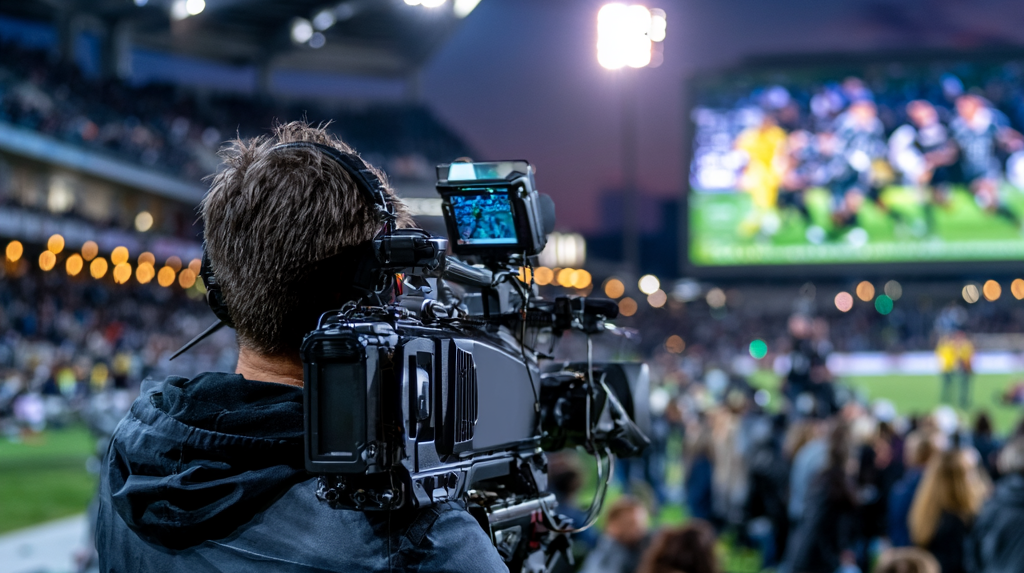
There is a hard truth in live sports broadcasting: the event does not care about your infrastructure gaps. A qualifier, a tournament weekend, or a high-stakes one-off match will expose every weak point in your distribution chain in real time — in front of the exact partners, sponsors, and rights holders you cannot afford to disappoint.
For executives responsible for rights management, distribution, and revenue delivery, Occasional Use (OU) is not a niche technical problem. It is a strategic risk category that requires deliberate investment and a repeatable operational model.
The Business Risk That Gets Dressed Up as a Technical Problem
When a live sports broadcast fails, the damage is immediate and multidimensional. Sponsors lose their placements. Rights partners in specific territories see content they were never supposed to see — or miss content they paid to receive. Your relationship with the rights holder takes a hit that no post-event debrief fully repairs.
What makes this particularly costly is that most of these failures trace back to decisions made well before broadcast day. Teams often default to one of two approaches, both of which carry serious downside risk.
The first is speed-first deployment: get the stream live on a public platform as quickly as possible and deal with the complications later. The complications usually include unreliable geo-controls, branding restrictions, monetization misalignment with existing contracts, and content appearing in territories where exclusivity has been sold to someone else. The Monday morning conversations that follow are not pleasant.
The second is over-engineering on a per-event basis: building a bespoke infrastructure for each one-off occasion, which is expensive, slow to deploy, and creates no operational advantage for the next event.
Neither approach scales. Neither protects your contractual obligations. And neither gives you the control that broadcast-grade live sports demands.
What Reliable OU Actually Requires
Reliable Occasional Use distribution is not about having the right software. It is about having a complete system — contribution, packaging, rights enforcement, delivery, and human oversight — that has been designed, tested, and validated as a single operational unit.
The points of failure that matter most to executives are not always the ones that get the most attention:
Contribution and ingest is where fragility starts. If the feed from the venue is unstable or dependent on a single connectivity path, the downstream distribution infrastructure becomes irrelevant. Primary and secondary ingest paths need to be genuinely independent — different carriers, different technologies, no shared failure domain.
Rights enforcement at the packaging layer is where legal exposure lives. Geo-blocking and DRM are standard requirements, but they need to be validated against the actual contractual territory map before the event goes live. A distribution glitch that places content in a rights-restricted territory is not a technical incident — it is a breach of contract.
Last-mile delivery is where viewer experience is won or lost. Multi-CDN distribution with active traffic steering ensures that a regional outage or peering bottleneck at one provider does not become a viewer-facing failure. Without end-to-end visibility, you will learn about regional problems from angry social media posts, not from your operations team.
24/7 human accountability is the layer that technology cannot replace. When systems behave unexpectedly during a live event, automated alerts are useful, but a staffed Network Operations Center with a clear escalation path is what determines whether an incident is resolved in minutes or becomes the story of the event.
The Case for a Hybrid Model
The operational standard for high-consequence live sports distribution is a hybrid approach that combines teleport-grade ingest with cloud-native playout. This model addresses the core tension in OU work: you need the reliability and signal integrity of professional broadcast infrastructure, but you also need the flexibility and speed of cloud deployment for events that are not permanent fixtures on the schedule.
Our iKOMG OU capability is built on exactly this model. The OU services combine physical teleport capacity with cloud delivery, covering satellite, IP, fiber, and CDN distribution from a single operational framework. This reduces the number of vendor handoffs during a live event — which directly reduces the number of places where accountability becomes ambiguous when something goes wrong.
The service set includes satellite capacity worldwide, SNG uplink, fiber and IP delivery, CDN streaming and monitoring, remote commentary, and small-scale production support. For executives evaluating OU partners, the practical significance of this breadth is that you are not assembling a patchwork of single-function vendors for each event. You are working with one team that owns the chain from ingest to delivery.
iKOMG also operates 24/7 global NOC and engineering support, which matters considerably during events that do not fall within standard business hours — which is most of them.
Our AI-powered highlight clipping tool, iKOCLIPS, adds a content generation dimension to the OU workflow. Highlights can be packaged and distributed in under 30 seconds, which is relevant for rights holders and distribution partners who need to push social and short-form content in parallel with the live broadcast.
Occasional Use (OU) Capabilities at a Glance
| Capability | Category | What it covers | Business value |
| Satellite capacity worldwide | Delivery | Global satellite uplink and downlink via iKOMG teleport infrastructure, covering all major continents | Venue-independent reach regardless of local ground infrastructure |
| iKOCLIPS — AI highlight clipping | AI | Automated AI-powered highlight generation delivering short-form clips in under 30 seconds for social and OTT distribution | Parallel content generation during the live window without additional post-production cost |
| 24/7 NOC & engineering support | Operations | Round-the-clock Network Operations Center with live monitoring, escalation paths, and engineering response across all active feeds | Single point of accountability — one team owns the chain from ingest to delivery |
| Instant deployment | Operations | Booking confirmation and operational activation within minutes, with scalable and flexible pricing structures for non-recurring events | Speed to air without requiring permanent infrastructure investment |
| iKOSYSTEM platform | Operations | Unified control platform giving customers visibility and operational control across satellite, cloud, OTT, and FAST channels from a single interface | Consolidated operational oversight — reduces the complexity of managing multiple distribution channels |
Conclusion
Every sports game or live event falls into the Occasional Use category. The infrastructure requirements do not change based on the size of the event. The stakes do.
iKOMG’s OU services are built for exactly this reality. From satellite ingest and fiber delivery to 24/7 NOC coverage and AI-powered highlight distribution through iKOCLIPS, the full chain is designed to operate as a single, accountable system. Rights enforcement is validated before broadcast, not discovered as a problem during it. Failover paths are tested, not assumed. And when something behaves unexpectedly during a live window, there is a staffed team with a clear escalation path — not an automated alert sitting in someone’s inbox.
For executives responsible for rights delivery and distribution performance, the question is not whether your next event justifies broadcast-grade OU infrastructure. It is whether you can afford the alternative.
Learn more about iKOMG OU
