
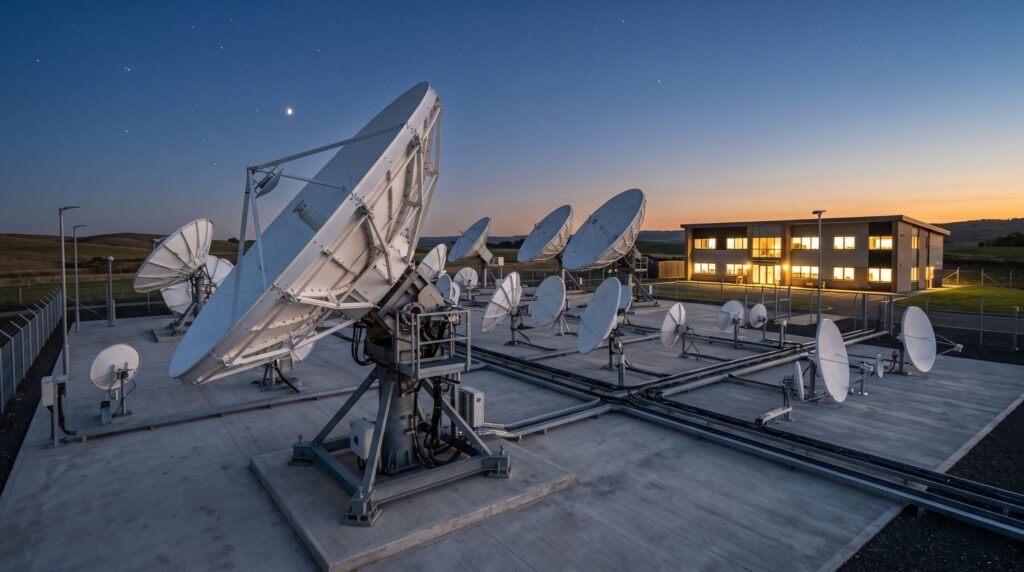
A satellite teleport is a ground station that uplinks and downlinks broadcast signals to and from orbiting satellites, the physical handoff point between a channel’s content and its audience. The World Teleport Association’s 2018 market study counted roughly 830 commercial teleports worldwide, operating more than 24,000 antennas and generating an estimated 10.4 billion dollars in annual revenue. Not every facility on that list is built the same way, and the gap shows up fastest during an outage. Broadcasters evaluating a provider need to weigh satellite access, fiber and IP integration, redundancy, and round-the-clock support as one package, not separate line items. We operate teleport facilities in Italy, Slovenia, and the Middle East that combine those elements into a single managed service for broadcasters and content owners.
Broadcasters should look for a wide satellite fleet and orbital arc, fiber-backed redundancy throughout the signal path, a staffed network operations center, and contractual clarity on uptime and disaster recovery. A teleport with plenty of dishes but no fiber diversity, or a skeleton crew behind a strong antenna count, tends to fail in the same predictable places. The sections below cover what to check at each layer, and where our own facilities fit.
What a teleport does inside the broadcast chain
A teleport receives a channel’s feed, by fiber, IP, or SNG truck, and converts it into a signal transmitted to a satellite transponder for downlink elsewhere in the world. On the receiving side, it does the reverse: pulling signals down from orbit and handing them to a broadcaster’s playout system. For most channels, the teleport is invisible until something goes wrong with it. A well-run facility is a utility, not a feature a viewer notices.
Broadcasters rarely evaluate a teleport on any single capability. They evaluate whether the whole chain, from ingest to uplink to monitored delivery, holds together under real conditions: peak traffic, a fiber cut, a power event, a satellite anomaly.
The technical baseline worth checking
Orbital arc coverage comes first. iKOMG’s Rome teleport lists over 40 satellite dishes ranging from 0.9 to 6 meters, covering an arc from 80 degrees East to 45 degrees West, per the company’s teleport specifications. That range determines which regions a channel can reach without a secondary hop through another provider’s facility.
Fiber and IP integration matters just as much as the satellite side. A teleport that only accepts satellite contribution forces a channel to build its own long-haul transport to reach the facility. We pairs Rome and Ljubljana with fiber and IP delivery reach across five continents, by its own account, so a channel can hand off over IP and let the teleport manage the satellite leg.
Redundancy is where facilities separate themselves the most. Dual power feeds, UPS backup, diverse fiber routes, and hitless switching between primary and backup paths are the difference between a brief glitch and an off-air channel. It’s also the category broadcasters check least carefully, since redundancy claims are easy to state and hard to verify without asking for the specific failover architecture.
Staffing and monitoring round out the baseline. A facility with dishes and fiber but no engineers on shift at 3 a.m. is a liability during a live event. We run our teleport operations under a 24/7 NOC: the standard broadcasters should expect, not an upgrade.
What a teleport contract can’t paper over
Teleport selection has limits that no amount of infrastructure fixes. A provider’s satellite access only extends as far as its transponder agreements, so a channel expanding into a new region may still need a secondary teleport regardless of how strong its primary provider is. Fiber diversity lowers the odds of a total outage but doesn’t remove the risk of a regional event degrading service anyway. SLA language is only as good as the incident history behind it; ask for uptime records and escalation timelines, not a percentage figure alone.
Where iKOMG’s teleport service fits
| Criterion | What to check | Why it matters |
|---|---|---|
| Orbital arc and satellite access | Range of orbital positions the facility’s dishes cover, and dish size range | Determines which regions and satellite operators a channel can reach directly |
| Fiber and IP integration | Whether the teleport accepts IP contribution and pairs it with fiber backhaul | Lets a channel hand off over IP instead of building its own long-haul transport |
| Redundancy architecture | Dual power, diverse fiber routes, hitless failover | Separates a brief signal drop from a full outage |
| Monitoring and staffing | 24/7 NOC with engineers on shift, not just automated alerts | Cuts the time between a fault and a resolved incident |
| Contractual transparency | Uptime history and disaster recovery terms, not just an SLA percentage | Gives a broadcaster something to hold the provider to during a real event |
iKOMG’s teleport facilities in Italy, Slovenia, and the Middle East are built around this same list: broad orbital arc coverage, fiber and IP delivery across five continents by the company’s own account, and a 24/7 NOC monitoring signal paths end to end. Channels on our teleports can also draw on its wider distribution stack, including cloud playout and OTT delivery, without routing traffic through a separate vendor.
How to weigh the options
The shortest way to evaluate a provider is to ask each candidate to walk through one failure scenario: what happens to the signal if the primary fiber route drops mid-broadcast. A provider with specific failover steps and a named backup path has usually built the redundancy it claims; one that answers in generalities usually hasn’t. Treat that question as a filter before comparing price or dish count.
