
What a live event distribution partner actually does that a rights holder cannot easily replicate alone, and where the line between in-house production and managed delivery sits.
Global sports rights spending reached 67.34 billion dollars in 2026, up 9.6 percent from 2025, according to S&P Global Market Intelligence. That growth means more live events, in more territories, with tighter delivery expectations than most rights holders can service alone. A rights holder can own the content and still not own a reliable path to every satellite footprint, fiber route, and platform an audience uses. Occasional Use, or OU, is the industry term for booking managed satellite, fiber, and IP delivery per event rather than owning infrastructure outright. iKOMG OU is built to handle that layer for rights holders, federations, and broadcasters event by event.
Rights holders need a distribution partner for live events because owning a rights package does not come with owning global transmission infrastructure, and building that infrastructure for occasional use rarely justifies the cost. Having a distribution partner does not mean handing over creative control; it means outsourcing the technical layer, satellite capacity, teleport uplink and downlink, fiber and IP transport, monitoring, and often commentary, so the rights holder can focus on production instead of ground infrastructure. This article explains what that layer involves, why building it in-house is usually the wrong call, and how a partner like iKOMG OU fits in.
What a live event distribution partner actually provides
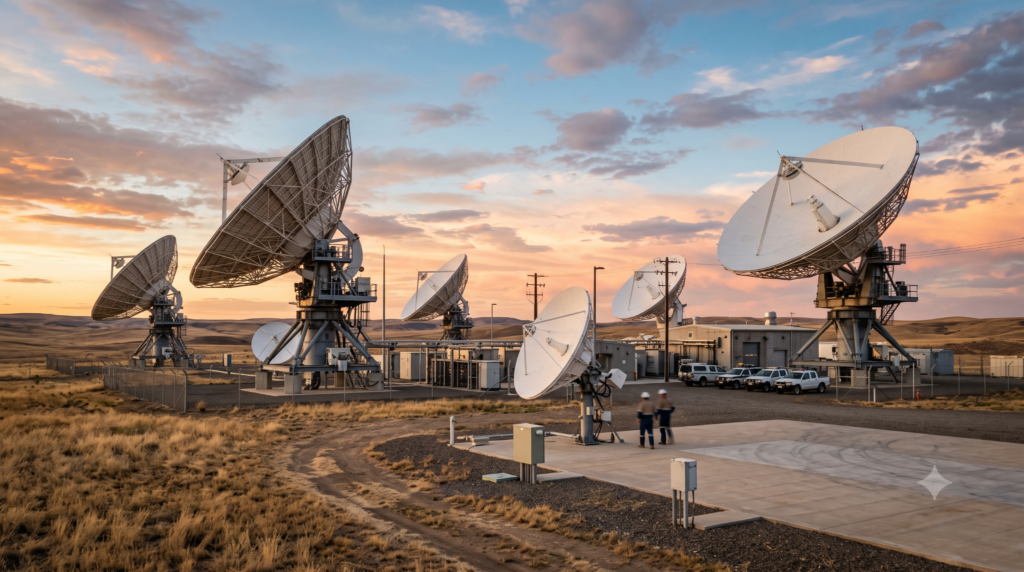
A distribution partner supplies the infrastructure a rights holder would otherwise build for a single event and then mostly leave idle: satellite capacity that reach the event’s target territories, teleport facilities to uplink and downlink the signal, fiber and IP transport for OTT and CDN delivery, and monitoring to catch a signal problem before viewers do. Around this core layer, partners increasingly bundle remote commentary, small-scale production support, and event coordination spanning multiple territories and time zones. The point is not just moving a signal from A to B; it is making sure the signal arrives everywhere it needs to, on time, without the rights holder negotiating satellite, teleport, and CDN contracts separately for every event.
Why rights holders do not build this infrastructure themselves
Infrastructure built for occasional use sits idle most of the time, and idle infrastructure is expensive. First, a rights holder would need satellite capacity and teleport access across every territory its rights cover, even though most events only need it for a few days. Second, they would need round-the-clock engineering staff on call for events that might happen once a month. Third, they would need contracts with multiple CDN and fiber providers for both satellite-served and IP-served audiences. A managed OU partner spreads that fixed cost across many rights holders, which is why booking per event is typically far cheaper than owning the infrastructure.
Learn about the Best Content Distribution Platforms for Independent Publishers: What to Look For
What a distribution partner does not solve
A distribution partner handles transmission, not audience acquisition. Booking global satellite and IP capacity gets a signal to every licensed territory, but it does not guarantee viewers to show up; marketing remains the rights holder’s job. OU delivery is also built around defined events, not continuous linear operation, so a rights holder running a full-time channel alongside occasional events typically needs both. Reliability depends on planning ahead, too: a signal path untested the day before is a common source of avoidable failures once an event goes live.
How iKOMG OU fits into a live event workflow
iKOMG OU is the Occasional Use division of iKO Media Group, operating across five continents with more than 20 satellite footprints and its own teleports, according to the company. Its services cover satellite capacity worldwide, fiber and IP delivery, teleport uplink and downlink, CDN streaming, SNG uplink, and event coordination, with 24/7 global NOC support during the event.
Do you know how commentary now runs on the same infrastructure as the signal? iKOMG OU and Spalk Forge Strategic Partnership to Transform Live Sports Broadcasting covers how that workflow was built for rights holders and federations.
| Feature | Detail | Why it matters |
|---|---|---|
| Coverage | 5 continents, 20+ satellite footprints | One OU relationship reaches most rights territories without separate vendor contracts per region |
| Core services | Satellite, fiber/IP delivery, teleport uplink/downlink, CDN streaming, SNG uplink | Covers the delivery chain a rights holder would otherwise assemble itself |
| Added services | Remote commentary and localization via Spalk, small-size production, event coordination | Extends managed delivery beyond the signal into commentary and production |
| Support | 24/7 global NOC support | Live events have no downtime tolerance, so monitoring matters as much as transmission |
Conclusion
Rights holders weighing whether they need a distribution partner should start from event frequency and territory spread. One running one or two events a year in a single region may manage with local production and a single CDN contract. One covering multiple continents, or needing satellite reach into regions with unreliable broadband, generally cannot replicate that footprint cheaply alone. A managed OU partner is then usually the more reliable path; evaluating one should include territory coverage, monitoring depth, and how far ahead it tests the signal chain before going live.
Have an event that needs global reach on a fixed date? Visit iKOMG to see how its OU team plans delivery for rights holders and federations.
