
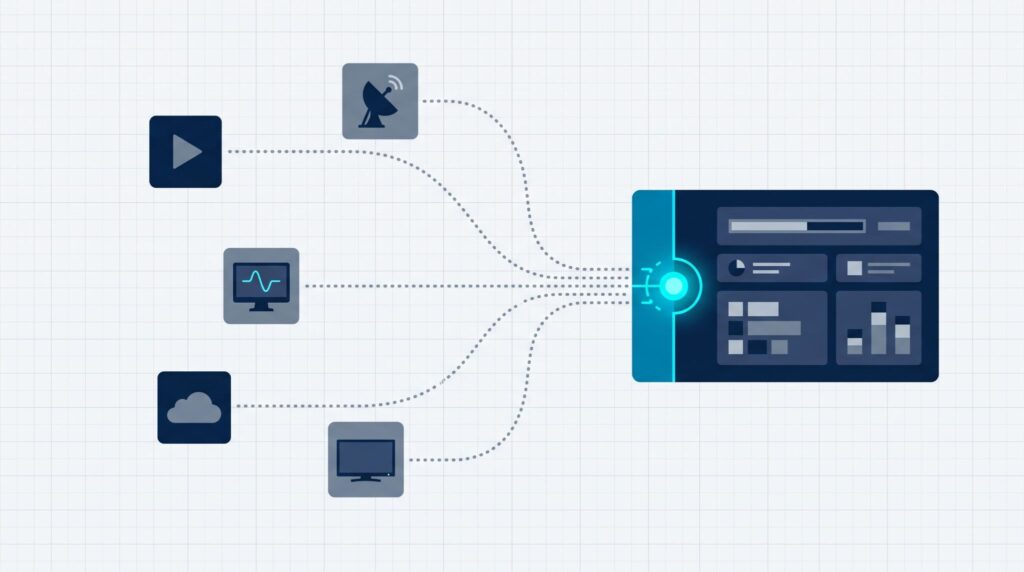
A unified broadcast operations platform brings playout, monitoring, EPG, OTT, and FAST management into one login and one dashboard instead of a separate system for each function. A 2026 report from Quickplay and Caretta Research found that broadcast production staff in North America spend up to 75 percent of their time on technical workflows rather than content work. Most of that time is not spent operating any single system; it’s spent moving between systems that were never built to talk to each other. Consolidating those systems onto one platform doesn’t eliminate the underlying work, but it does eliminate the coordination layer that broadcasters have historically had to build and staff themselves. iKOSYSTEM is our version of that consolidation layer, bringing a customer’s subscribed services into a single secure login.
Unified platforms reduce cost and staffing needs mainly by cutting coordination overhead, not by replacing the specialist systems underneath. A broadcaster running six disconnected systems needs staff time to check six dashboards, reconcile six sets of alerts, and escalate to six separate support contracts during an incident. Collapsing that into one login and one view removes the checking and reconciling. That reconciling work is where a surprising share of operational labor actually goes.
What unified changes in day-to-day operations
Most broadcast operations run playout, monitoring, OTT distribution, and FAST channel management as separate systems, each with its own login and support contract. An operator confirming that a channel is healthy end to end has to check each one individually, then manually piece together what’s actually happening across the signal path. A unified platform replaces that manual assembly with a single dashboard. iKOSYSTEM does this through a modular, tile-based interface where each subscribed service, playout, monitoring, OTT, EPG, FAST, clipping, appears as a tile inside the same login rather than a separate destination.
Where the cost and staffing savings actually come from
The mechanism is coordination cost, and it scales faster than the number of vendors involved. Two disconnected systems need one integration point tracked manually. An operator first has to notice something is wrong, usually by comparing outputs across systems that were never designed to be compared. They then have to determine which vendor owns the problem before escalating to that vendor’s separate support process. None of those steps is difficult in isolation; stacked together under time pressure, they’re what turns a five-minute fix into an hour-long outage staffed by three people instead of one.
Curious where that fragmentation actually starts? Why Are Broadcast Operations Becoming Fragmented Across Multiple Vendors? breaks down how it builds up and why it tends to worsen as broadcasters add distribution channels.
Staffing needs drop specifically in the coordination role: the person or team whose job is comparing dashboards and routing tickets, not the engineers who run the underlying satellite, cloud, or OTT infrastructure. A broadcaster with a smaller team can cover more distribution channels because less of each person’s day goes to manually cross-referencing systems.
What consolidation doesn’t change
A unified dashboard changes how operations are managed, not what infrastructure a broadcaster runs underneath it. iKOSYSTEM organizes and monitors the services a customer already subscribes to; it isn’t a replacement for satellite capacity, teleport infrastructure, or the playout and delivery systems themselves, and those still need engineers who understand them. The platform also only unifies the services within a given provider’s own catalog. A broadcaster running third-party tools alongside our services would still manage those separately until they’re also brought onto the same stack. And migrating onto any unified platform takes a rollout period; teams accustomed to individual dashboards need time to retrain on a consolidated one before the staffing benefit shows up in practice.
For more on where a single-platform approach has boundaries, see Is There a Unified Platform for Broadcasters?, which covers what it does and doesn’t replace.
Where iKOSYSTEM fits
| Function consolidated | What It Provides | What it replaces | Why it matters for cost and staffing |
|---|---|---|---|
| Access and login | One login across playout, monitoring, EPG, OTT, and FAST modules, inside the iKOSYSTEM portal | Separate credentials for playout, monitoring, EPG, OTT, and FAST | Removes the daily overhead of managing multiple logins per operator |
| Monitoring and alerts | A single dashboard that pulls status and alerts from across the subscribed services into one view | Comparing outputs across standalone dashboards | Cuts the diagnosis time that turns a short fix into a staffed, multi-hour incident |
| Support escalation | One point of contact for issues spanning multiple services | A separate support contract per vendor per system | One provider to contact instead of routing tickets across several |
| Service scope | Subscription activation of iKOBMS, iKOCLOUD, iKOPLUS, iKOGUIDE, iKOCLIPS, iKOFAST, iKOOTT, and iKOQ | iKOBMS, iKOCLOUD, iKOPLUS, iKOGUIDE, iKOCLIPS, iKOFAST, iKOOTT, iKOQ | Services activate with a subscription rather than a new integration project |
iKOSYSTEM is available at no additional platform cost to customers already subscribed to the underlying services. That removes the usual barrier to testing whether centralized visibility changes staffing needs before committing to any broader infrastructure change.
How to gauge the potential savings
The simplest way for a broadcast leader to estimate the opportunity is to count logins: how many separate systems does a duty engineer check to confirm a channel is healthy end to end. Two or three is manageable with a specialist covering each. Beyond that, the coordination cost usually outweighs the benefit of a dedicated tool for every function, and that gap is exactly what a unified platform is built to close.
