
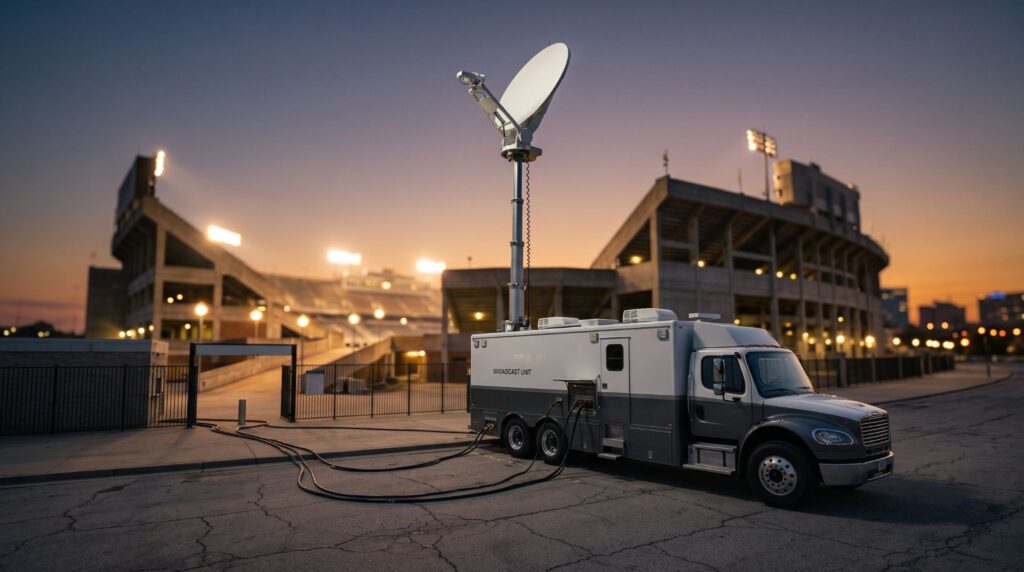
Broadcasters reach global audiences by booking transmission capacity that someone else already owns, for the exact window an event needs, rather than building a network of their own. This booking model is called Occasional Use, or OU, and it is the standard mechanism behind live sports and event distribution worldwide. Global sports rights spending reached 67.34 billion dollars in 2026, up 9.6 percent from 2025, according to S&P Global Market Intelligence, and nearly all of that content still has to physically leave the venue. Capacity providers typically offer OU windows from as little as 15 minutes to about a month, confirmed on short notice rather than through a long procurement cycle. iKOMG OU packages that booking process, plus the teleport, fiber, and monitoring layers behind it, into a single relationship for rights holders and broadcasters.
Broadcasters distribute live sports worldwide by booking satellite transponder time, teleport uplink slots, and fiber or IP circuits from providers who already own that infrastructure, paying only for the event window rather than a permanent lease. The mechanism works because satellite and fiber capacity is a rentable resource with a spot market behind it, the same way cargo space or cloud compute gets sold in units rather than owned outright. A broadcaster covering a weekend tournament doesn’t need a teleport; it needs someone else’s teleport for two days.
What actually gets booked
An OU booking covers a specific set of resources, not a vague satellite time line item. On the space segment side, that transponder capacity is measured in megahertz and hours, typically the smallest usable slice a satellite operator will sell for a single event. On the ground side, it’s teleport access: an uplink slot to get the signal onto the satellite, and often a downlink slot at the receiving end. Increasingly, the same booking also covers fiber or IP circuits, since most live events now deliver a hybrid feed rather than pure satellite. iKOMG’s own teleports in Italy, Slovenia, and the Middle East handle this ground-segment role — with the Slovenia facility recognized as the group’s award-winning flagship site — paired with fiber and IP delivery reach across five continents.
How the on-demand market actually functions
Satellite operators hold inventory they can’t fill with permanent channel leases, since demand for any single orbital slot swings with the sports calendar. Rather than letting that capacity sit idle, they sell it in short windows to whoever needs it that week. A rights holder or broadcaster doesn’t usually deal with the satellite operator directly; an OU provider aggregates access to multiple operators, teleports, and fiber routes, and sells the broadcaster one booking instead of five separate contracts.
Curious what Occasional Use actually means as a category before booking one? What Is Occasional Use (OU) in Broadcasting? breaks down the terminology and booking windows in more detail.
That aggregation is the part broadcasters actually pay for. Booking transponder time alone still leaves a broadcaster needing a teleport to uplink the signal and a fiber contract to deliver it onward to OTT or CDN platforms. An OU provider bundles all three into one relationship, confirmed and activated within minutes for a planned event rather than negotiated separately across three vendors.
What an OU booking doesn’t cover
An OU booking is a capacity mechanism, not a full production or rights service. It gets a signal from a venue to a distribution network; it doesn’t handle rights management, territory-level geo-blocking, or DRM, which stay the rights holder’s responsibility to define and configure with whichever platform enforces them. It also doesn’t cover on-site production quality: camera work, graphics, and commentary setup happen before the signal reaches the OU provider’s network, though some providers bundle adjacent services like remote commentary on top of the core booking. And OU pricing assumes a defined event window; a broadcaster running a channel continuously alongside occasional live events typically needs a separate standing capacity contract for the channel itself.
For more on why building this layer in-house rarely pencils out for a rights holder, see Why Do Rights Holders Need a Distribution Partner for Live Events?
Where iKOMG OU fits
| What’s booked | What iKOMG OU provides | Why it matters |
|---|---|---|
| Satellite capacity | Worldwide transponder access booked per event | Reaches territories a broadcaster can’t serve with IP delivery alone |
| Teleport uplink/downlink | Teleports in Italy, Slovenia and the Middle East, plus partner network | Gets the signal on and off the satellite without owning ground infrastructure |
| Fiber and IP delivery | Reach across five continents, by iKOMG’s own account | Covers hybrid feeds that combine satellite with IP contribution |
| Monitoring | 24/7 network operations center | Catches a degrading path before it takes the feed off air |
| Added services | Remote commentary through a partnership with Spalk | Bundles commentary onto the same booking instead of a separate vendor |
How to evaluate a booking
The practical question for a broadcaster isn’t whether to use Occasional Use; the model is the industry default for episodic events. It’s how many separate vendor relationships a given booking actually collapses into one. A provider that only sells transponder time still leaves the teleport and fiber legs to arrange separately. One that bundles space segment, ground segment, and delivery into a single confirmed booking is doing the aggregation work the model exists for in the first place.
