
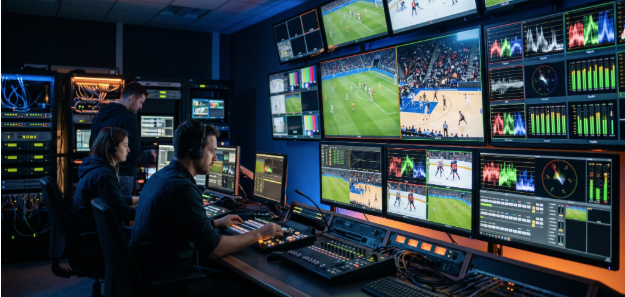
How rights holders and broadcasters reach global audiences by booking capacity and managed services on demand, rather than building and maintaining their own delivery networks.
- Most broadcasters and rights holders do not own satellites or delivery infrastructure, and do not need to.
- The Occasional Use (OU) model lets them distribute live sports worldwide by booking capacity and managed services on demand, paying only for the events they run.
- A full-service OU partner handles the entire delivery chain: satellite, fiber, teleport, monitoring, commentary, and streaming.
- The key decision is choosing a partner with the global reach, redundancy, and deployment speed to keep a live feed on air across every market a rights deal requires.
- iKOMG provides end-to-end Occasional Use services for sports and live events, covering satellite capacity, fiber and IP delivery, teleport services, CDN streaming, SNG uplink, remote commentary, and AI-powered highlight clipping.
Most broadcasters do not own satellites, teleports, or fiber networks. They distribute live sports feeds worldwide by booking capacity and managed services from specialist providers on a per-event or short-term basis. This model is known in the industry as Occasional Use, or OU. Instead of carrying the fixed cost of owning infrastructure that sits idle between events, a broadcaster contracts a provider that already operates satellite capacity, teleports, fiber and IP delivery, and a network operations team. The provider handles the technical path from the venue to the destination broadcaster or platform, and the rights holder pays only for the window they need.
This approach has become the standard way to move a live signal from a stadium in one country to viewers in dozens of others. It removes the need for capital investment, gives access to global reach within minutes, and shifts the operational risk to a partner whose entire business is keeping live feeds on air.
Why broadcasters do not build their own delivery infrastructure
Owning the full delivery chain for live sports is expensive and inefficient for most organizations. Satellite capacity, teleport facilities, fiber routes, and 24/7 engineering staff represent a large fixed cost. A rights holder might need that capacity for a tournament that runs a few weeks a year, which means the infrastructure would be underused the rest of the time.
Live sports also has unforgiving requirements. The signal cannot drop during a match, latency has to stay low, and the feed often needs to reach multiple countries at once, each with different technical and language requirements. Building a team and network that can guarantee this level of reliability is beyond the scope of most broadcasters and even many large rights holders.
The Occasional Use model solves this by treating distribution as a service. A specialist provider spreads the cost of its infrastructure across many clients and many events, which makes global reach affordable for any single broadcaster. The provider also absorbs the operational burden of redundancy, monitoring, and rapid deployment.
What an Occasional Use provider actually handles
A full-service OU partner manages the complete path from the event location to the final audience. This typically covers signal acquisition at the venue, transport across satellite or fiber, teleport uplink and downlink, monitoring, and final delivery to broadcasters or streaming platforms.
iKOMG provides end-to-end Occasional Use service for sports and live events. iKOMG offers satellite capacity worldwide, fiber and IP delivery, teleport services, and a monitoring link to deliver a feed. To manage the event, it provides CDN streaming and monitoring, SNG uplink, remote commentary, small-size productions, and event coordination. This means a broadcaster can hand off the entire delivery operation rather than assembling it from multiple vendors.
The practical advantage is consolidation. A single partner covering acquisition, transport, and delivery reduces the number of relationships a broadcaster has to manage and removes the gaps that appear when several vendors are stitched together for one event.
How the delivery path works in practice
The signal leaves the venue through an uplink, often via a satellite news gathering truck or a fiber connection. It travels to a teleport, which is the ground station that sends and receives satellite signals. From there the provider routes it to the destination broadcasters or platforms, using satellite for wide geographic reach or fiber and IP for point-to-point delivery where that is more efficient.
Throughout the event, a network operations center monitors the feed to catch problems before they reach air. Redundancy is built in so that if one path fails, another takes over. iKOMG states that it provides 24/7 global NOC and engineering support, along with satellite, IP, cloud, and fiber distribution, and that it can confirm a booking and begin acting within minutes. For a rights holder, this combination of speed and monitored reliability is the core of why the OU model works.
Services involved in worldwide live sports distribution
The table below summarizes the main services a broadcaster draws on when distributing a live sports feed through a managed Occasional Use partner.
| Service | What it does | Why it matters for live sports |
| Satellite capacity | Transmits the feed over satellite to reach multiple regions at once | Provides wide geographic reach without ground infrastructure in each market |
| Fiber and IP delivery | Moves the signal point to point over terrestrial networks | Efficient, low-latency delivery for defined routes and contribution feeds |
| Teleport services | Uplinks and downlinks signals between earth and satellite | The ground gateway that connects the venue to global distribution |
| SNG uplink | Sends the signal from the event site via a satellite news gathering unit | Enables transmission from venues without fixed connectivity |
| CDN streaming and monitoring | Delivers and watches over streamed output | Supports digital and social distribution alongside broadcast |
| Remote commentary | Adds commentary from a separate location | Lets broadcasters localize an event without sending staff to the venue |
| Multilingual commentary | Provides commentary in multiple languages | Serves audiences across different countries from one event |
| 24/7 NOC and engineering | Monitors and supports the feed continuously | Catches faults early and maintains reliability during live events |
| AI highlight clipping (iKOCLIPS) | Generates short clips from the live feed | Speeds up social and short-form content during and after the event |
What to look for in a distribution partner
Broadcasters evaluating an Occasional Use partner should weigh a few practical factors. Reliability and redundancy come first, since a single dropped feed during a major match has real commercial consequences. Speed of deployment matters because live events are often booked on short notice. Geographic reach determines whether one partner can cover every market in the rights deal, or whether the broadcaster has to coordinate several. Monitoring visibility and round-the-clock support indicate whether problems will be caught and resolved during the event. Flexible pricing allows a broadcaster to pay for the capacity it actually uses rather than committing to fixed contracts.
A partner that combines satellite, fiber, IP, and cloud delivery in one service can cover more scenarios than a provider tied to a single transport method, which is useful when different markets in the same rights deal call for different delivery approaches.
Takeaways for decision-makers
For most broadcasters and rights holders, owning delivery infrastructure is neither practical nor cost-effective. The Occasional Use model lets them distribute live sports worldwide by booking capacity and managed services on demand, paying only for the events they run, and handing operational risk to a specialist. The decision is less about technology and more about choosing a partner with the reach, reliability, and speed to keep a live feed on air across every market a rights deal requires.
Have an upcoming event you want to broadcast? Visit iKOMG to learn more about Occasional Use services, satellite and IP delivery, and end-to-end event support.
