
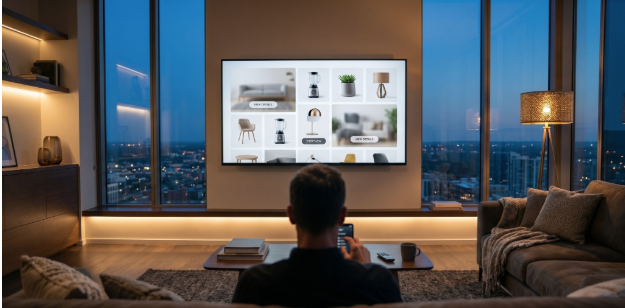
How broadcasters and content owners are turning interactive viewing into measurable revenue, and what has to be in place before the first overlay goes live.
- Interactive TV has moved from experiment to a real revenue line, covering shoppable ads, addressable advertising, QR engagement, pay-per-view, and interactive subscription bundles.
- No single model fits everyone. The right choice depends on your audience, your distribution footprint, and how mature your technology already is.
- The formats only work if the foundation is solid: a steady supply of content and reliable delivery across every screen and region your audience lives in.
- iKOMG provides that foundation through content aggregation, multi-screen delivery, a connected TV ad marketplace, and satellite-plus-OTT reach via FAST on SAT, all within one managed-service model.
You are watching a cooking show and the host pulls out a pan you have been hunting for. Your first instinct is to grab your phone and search for it. Now imagine skipping that step. You tap the screen, the product details appear over the video, and you check out without ever leaving the episode. Interactive TV makes that possible, and it is starting to show up on broadcaster balance sheets. The phase where this was a neat idea worth testing is over. It is a real line item now.
What Interactive TV Actually Means
Interactive TV is any TV or video experience that lets a viewer take an action without leaving playback. They can shop, vote, request information, or respond to an ad. It is the umbrella term, and underneath it sit a few specific approaches.
Shoppable TV puts product links inside the content or the ad so viewers can buy directly from the screen. Addressable TV delivers a different ad to different households watching the same program, rather than the same spot to everyone. Interactive overlays cover the calls to action, QR codes, and polls built into the viewing experience.
Early versions of this go back further than most people remember, from red-button features to SMS voting on reality shows. What changed is the combination of streaming scale, smarter advertising technology, and devices that can finally handle the experience without breaking. The question for executives is no longer whether the technology works. It is how to turn it into revenue.
The Models That Make Money
There is no single interactive TV revenue model. The right one depends on your audience, your distribution footprint, and how mature your technology already is. The table below maps the main options to the revenue they generate and the audience they suit.
| Monetization Model | How It Earns | Best Audience Fit | Why It Works |
| Shoppable / Interactive Ads | Ad fees plus commerce commission | Connected TV and OTT viewers | Captures purchase intent at the moment it appears |
| Addressable Targeted Ads | Premium ad rates for matched audiences | Broadband and satellite households | Same airtime sold at a higher price |
| QR-Driven Engagement | Sponsorship value, lead generation, donations | Linear TV and FAST viewers | Low setup cost, measurable from day one |
| Pay-Per-View / Micropayments | Direct viewer payments per event | Sports and premium live events | Monetizes high-demand moments directly |
| Subscription Bundles | Recurring subscription revenue | Loyal, repeat viewers | Increases retention and revenue per user |
These models are not mutually exclusive. Many platforms run two or three at once, using addressable ads for general inventory, QR codes for live events, and pay-per-view for premium moments. Addressable advertising gets the most attention, but QR-driven engagement is where smaller broadcasters tend to move fastest, because it does not require an audience data layer they do not already have.
Why Content and Delivery Come First
Here is the part that often gets skipped in interactive TV conversations. None of these revenue models work if you do not have content to wrap them around and a reliable way to deliver it. The interaction is the last mile. The first mile is having enough programming, in the right formats, reaching the right screens.
This is where the foundation matters more than the overlay. iKOMG’s content aggregation and distribution service gives operators access to more than 400 live TV channels and over 7,000 on-demand assets across sports, music, kids, and news, delivered with worldwide CDN support and a single invoice that covers both the content license and the delivery. For an executive building an interactive channel, that solves a problem that comes before any of the fancy formats: you need inventory to monetize, and you need it to arrive reliably on every device your audience uses, whether that is web, mobile, or connected TV.
The same service also includes a connected TV advertising marketplace built to fill ad inventory across multiple demand sources at the highest possible rate. That is the commercial engine behind shoppable and addressable formats. iKOMG positions this inside a broader managed-service model, which means a broadcaster can source content, deliver it across satellite and IP, and layer monetization on top through one partner rather than stitching together five vendors.
That last point is where delivery reach becomes a strategic question. A broadcaster serving satellite households, especially in regions like MENA where broadband coverage is uneven, needs an interactive approach that works beyond the broadband-only stack. iKOMG’s FAST on SAT model extends free ad-supported channel delivery via satellite to a large base of MENA households that pure OTT infrastructure cannot reach.
The Takeaway
Interactive TV has moved from a research curiosity to a real entry in monetization plans. It works when you build it on a solid base and breaks when you rush it. The platforms that win will be the ones that get the foundations right first: a steady supply of content, reliable delivery across every screen and region their audience lives in, and honest measurement. The overlay is the easy part. The infrastructure underneath it is what decides whether the revenue is real.
If you are evaluating how to layer interactive or addressable monetization onto your existing broadcast or OTT setup, or you need a content and delivery foundation that reaches audiences across both broadband and satellite, it is worth mapping your current footprint against the models above. Talk to the iKOMG team to see what an interactive pilot could look like for your channels.
